Hamilton to Tauranga Corridor Spatial Study
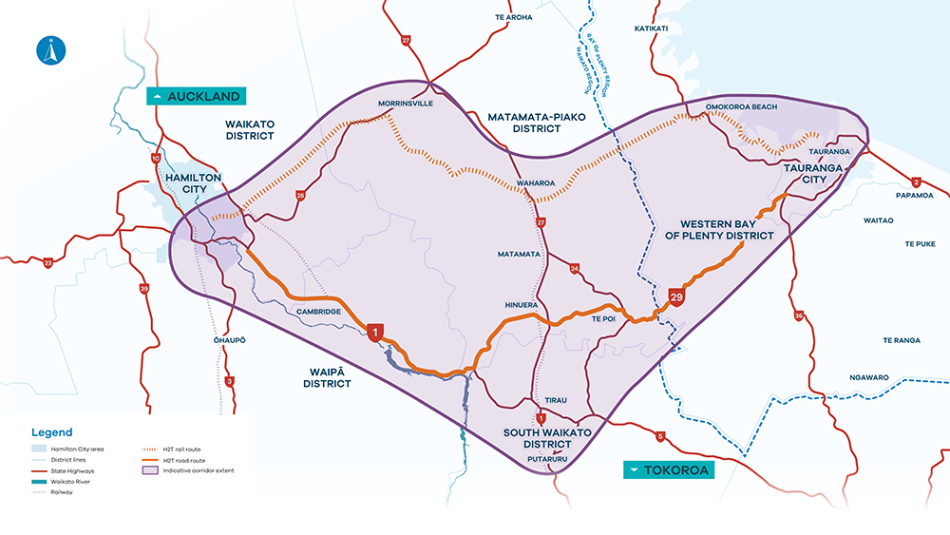
![View a larger version of the map [PNG, 307 KB]](/assets/Future-Proof/HamiltonToTaurangaMap.png)
Future Proof, in partnership with SmartGrowth, has completed a year-long study that identifies the potential growth impacts of transport improvements in the Hamilton to Tauranga Corridor, an important leg of the Upper North Island’s Golden Triangle.
This area spans over multiple territorial boundaries including Hamilton City Council, Matamata-Piako District, Waipā District and South Waikato District.
The study provides a clear understanding of the growth area’s unique needs and potential, and will help ensure that future growth and the necessary transport, water and utility infrastructure is coordinated and aligned. It aimed to determine how development can be managed in the best way possible – supporting economic outcomes, as well as protecting the environment and our communities.
Quick facts
Within the Corridor:
-
The population has increased from just over 250,000 in 1996 to more than 450,000 in 2024.
-
Employment has doubled from 139,650 in 2000 to over 258,000 in 2024.
-
There are over 300 planned developments.
-
Around 900-1,000 additional dwellings are expected from the transport improvements in the next 30 years.
-
An additional 26ha of industrial land and 11ha of commercial land is expected over the next 30 years.
-
The economic activity arising from this extra development could generate an additional $200m of GDP (Gross Domestic Product) in the Waikato region and $130m of GDP in the Bay of Plenty Region.
Findings of the study
The study found that, in addition to the high growth already predicted in the Corridor, planned transport improvements are expected to generate more development throughout the Corridor.
This additional growth is expected to continue to occur mostly at either end of the corridor – in the metro cities of Hamilton and Tauranga.
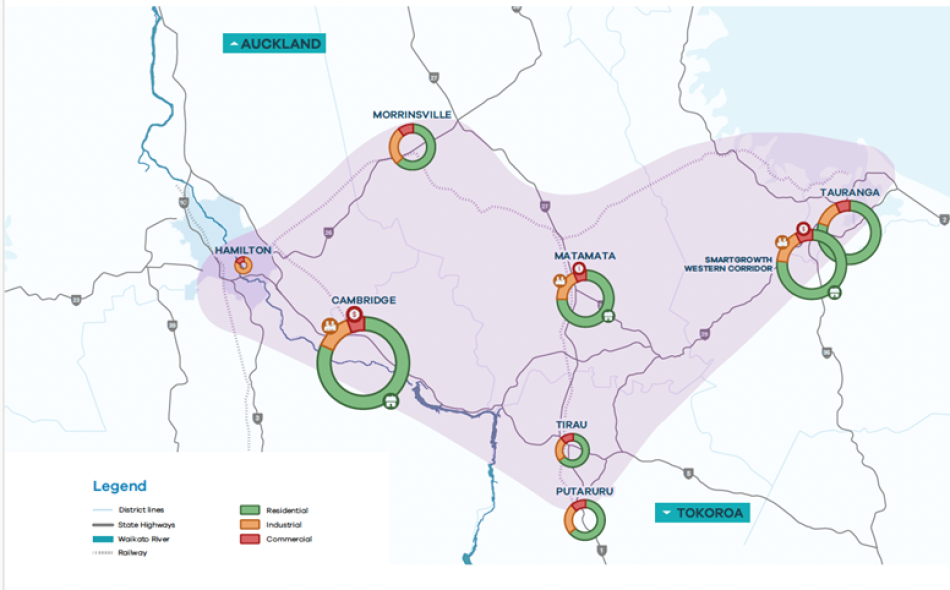
In the medium-long term, there is also expected to be significant potential growth in the central towns of Matamata, Tirau and Putāruru, and the proportion of growth occurring in this central area could gradually increase over time.
The growth created by the transport investment is not projected to require the creation of new stand-alone urban areas within the Corridor.
Both regions are well placed to accommodate the expected additional growth because of the existing spatial planning work already completed and underway by Future Proof and SmartGrowth. The study confirms both regions are on the right track and our growth strategies are continuing to guide the right type of growth, in the right way, in the right place.
Most likely scenarios
The Metro Growth Scenario is the most likely in the short-medium term: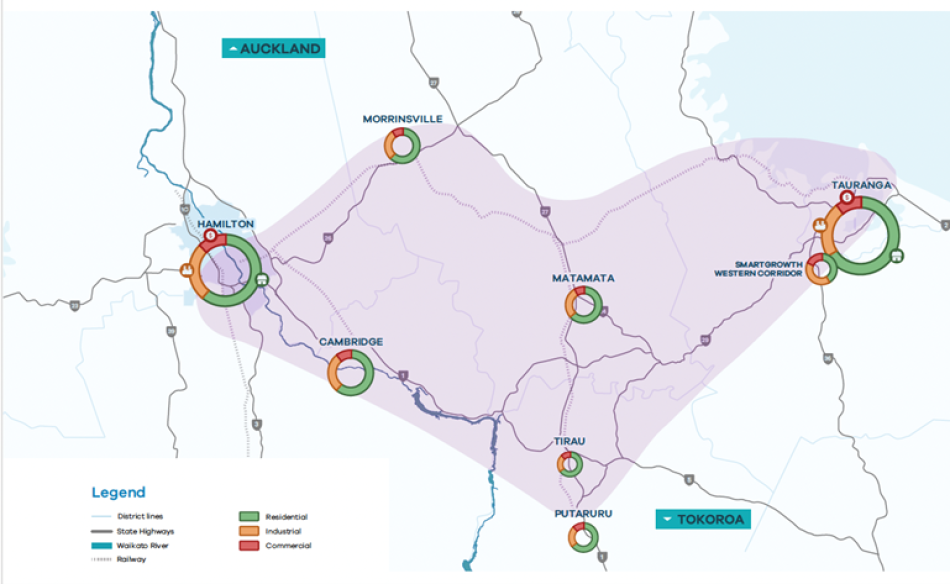
A shift towards the Central Growth Focus Scenario is likely in the medium-long term:
What's next
The findings from this study will be of huge benefit as we plan for the future and will be used to influence the future Regional Spatial Plans that are being proposed under new planning legislation.
The findings will also influence other studies such as the NZ Transport Agency’s current strategic transport study of the Hamilton to Tauranga (H2T) corridor.
Future Proof and SmartGrowth both agreed to a programme of monitoring to keep the findings up-to-date.
Cross-regional planning in action
The report is a prime example of cross-regional planning. The study was endorsed by the Future Proof Implementation Committee in February 2026 and endorsed by the SmartGrowth Leadership Group in March 2026.
!['No - Go' area map [PNG, 2.6 MB]](/assets/Future-Proof/No-Go.png)
!['Go Carefully' area map [PNG, 3.2 MB]](/assets/Future-Proof/Go-Carefully.png)
![Combined 'No - Go' and 'Go Carefully' area map [PNG, 2 MB]](/assets/Future-Proof/No-Go-and-Go-Carefully.png)